Interdental Brushes & Wooden Sticks: How to Do It Right
A calm, step-by-step introduction for anyone who wants to start cleaning between their teeth and molars.
Brushing alone is not enough
The spaces between your teeth and molars are where tooth decay and gum disease most often begin. A regular toothbrush can barely reach those areas. Interdental brushes and wooden sticks fill that gap — literally.
Starting right is half the battle. On this page you'll find exactly how to go about it, what to expect, and how to turn it into a lasting habit.
Watch the video first
The video below shows in a short time how to handle an interdental brush or wooden stick. Pay close attention to how the hand is stabilised — that is exactly what we go into further below.
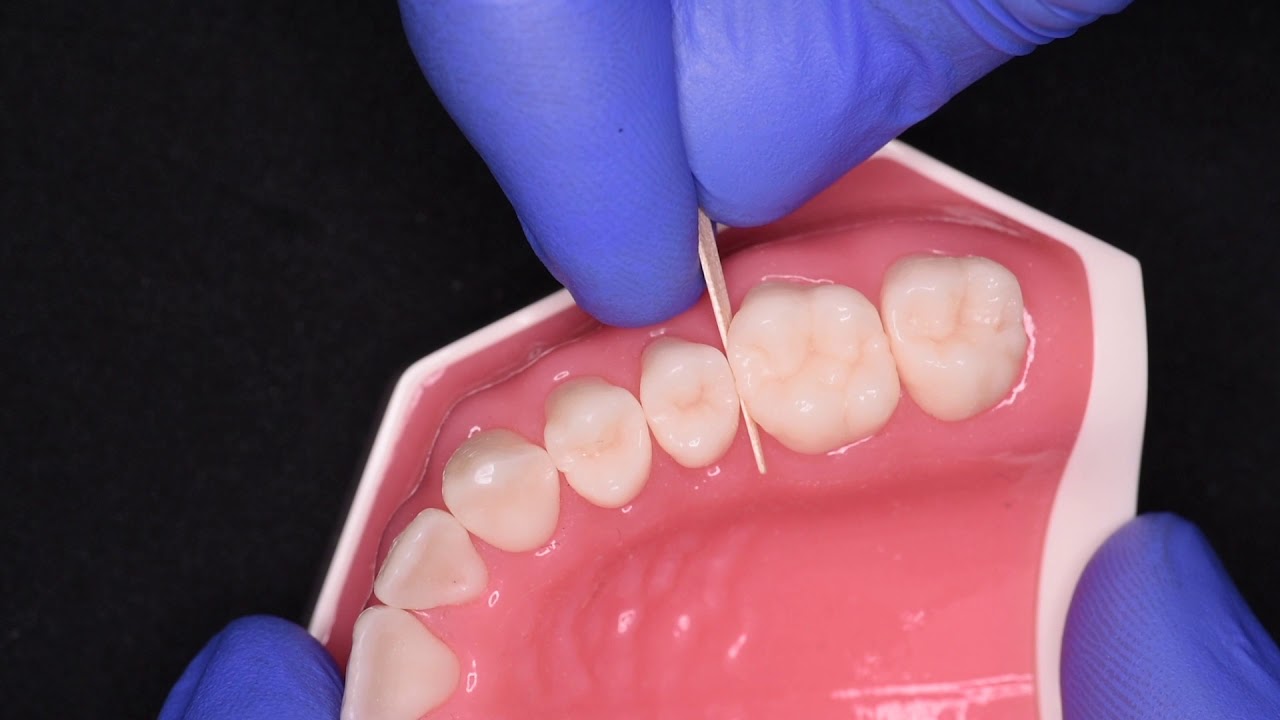
Watch the instructional video on YouTube
Step by step: how to use an interdental brush or wooden stick
The biggest secret is not the brush itself, but how you hold and guide it. Getting this right prevents bending and lets you work much more precisely.
Hold the brush or stick between your thumb and index finger. Then lightly rest your other fingers against your cheek or chin. Without that support your hand has nothing to anchor against, the brush bends easily, and you frequently miss the gap. With support you work calmly, precisely, and safely.
- Choose the right size. The brush should feel light resistance as you pass it through. Too small: it doesn't clean properly. Too large: it hurts and damages the gum. Ask your dental hygienist for help choosing the first time.
- Hold it correctly. Hold the brush or stick between your thumb and index finger, close behind the bristle head or tip — not at the far end of the handle.
- Brace your hand. Rest the remaining fingers of the same hand gently against your cheek or chin. This is your anchor: it lets you steer without jabbing.
- Gently pass it between the teeth. Don't force it. If it won't go, try a smaller size or a wooden stick instead.
- Move slowly back and forth. Two to three passes in and out is enough to dislodge plaque. Then move on to the next gap.
- Rinse. Briefly rinse the brush under water. Replace it when the bristles look frayed, or when the stick feels worn.
An interdental brush has a small bristle head and is ideal when there is enough space to pass it through comfortably. A wooden stick works better in narrow spaces or around braces and bridges. Sometimes you use both.
Be kind to yourself — it gets easier
You don't have to be able to reach every gap right away. That's completely normal. Start with the places where you can manage, and slowly expand. Your fine motor skills adapt, your fingers learn the movement, and after a few weeks it happens almost automatically.
Some gaps are narrower than others, some teeth are slightly tilted. Give yourself time.
This is probably the most common reason people stop — when in fact they should keep going. Gum tissue that is already inflamed (and it likely has been for some time) bleeds more when you first disturb it. Keep going in the places where you can manage. The gums will recover, and the bleeding will ease on its own.
days — and you'll see the difference
In most cases there is a clear improvement within two weeks: less bleeding, gums that feel healthier, and a fresher feeling in the mouth.
What beginners run into
Almost everyone recognises one or more of the situations below. Know that they are normal and that there is a solution for each one.
- "The brush won't fit between my teeth." Try a smaller size. If that doesn't work either, a wooden stick or a specialist narrow-space brush is a good alternative. Ask your dental hygienist for advice.
- "I keep bending the brush." Almost always a grip issue: hold your fingers slightly closer to the bristle head and brace your hand better against your cheek or chin. A gentle, slightly rocking motion also helps.
- "The bleeding in the first few days was worse than I expected." This is normal — and actually a sign that you're reaching exactly the right spots. The gum was already inflamed; you just didn't notice it. Keep going where you can, and it will recover quickly.
- "I simply forget to do it." That's not a lack of willpower — it's a missing habit. Further down this page you'll find how to change that.
- "It takes so long." At the start, yes. Once the movement becomes automatic, you'll be done in under two minutes. Have a little patience — it gets easier on its own.
- "I keep hitting the gum." Check that you're guiding the brush straight into the gap (not angled up or down) and that you're bracing sufficiently. Using a mirror for the first few weeks makes a huge difference.
How do you make it a lasting habit?
Behaviour research shows that new habits stick most easily when you attach them to something you already do, keep it as simple as possible, and don't demand perfection of yourself right away.[8]
Do it at the same moment every day — for example, directly after brushing your teeth before bed.
Leave the brushes or sticks next to your toothbrush — or even better — on your bedside table.
Begin with the gaps that are easiest. The trickier spots will follow in time.
Tick it off in an app or on a calendar. Visible progress motivates more than you'd expect.
Especially at the start: you can see what you're doing and learn the movement much faster.
A partner or housemate who knows you're working on it is a subtle but effective nudge.
Would you like to save this article?
Send it to yourself or someone else by email
Scientific references
- Slot DE, Dörfer CE, Van der Weijden GA. The efficacy of interdental brushes on plaque and parameters of periodontal inflammation: a systematic review. Int J Dent Hyg. 2008;6(4):253–264. doi:10.1111/j.1601-5037.2008.00330.x
- Poklepovic T, Worthington HV, Johnson TM, et al. Interdental brushing for the prevention and control of periodontal diseases and dental caries in adults. Cochrane Database Syst Rev. 2013;(12):CD009857. doi:10.1002/14651858.CD009857.pub2
- Van der Weijden FA, Slot DE. Efficacy of homecare regimens for mechanical plaque removal in managing gingivitis — a meta-review. J Clin Periodontol. 2015;42(Suppl 16):S77–S91. doi:10.1111/jcpe.12359
- Chapple ILC, Van der Weijden F, Doerfer C, et al. Primary prevention of periodontitis: managing gingivitis. J Clin Periodontol. 2015;42(Suppl 16):S71–S76. doi:10.1111/jcpe.12366
- Salzer S, Slot DE, Van der Weijden FA, Dörfer CE. Efficacy of inter-dental mechanical plaque control in managing gingivitis — a meta-review. J Clin Periodontol. 2015;42(Suppl 16):S92–S105. doi:10.1111/jcpe.12363
- Lertpimonchai A, Rattanasiri S, Arj-Ong Vallibhakara S, Attia J, Thakkinstian A. The association between oral hygiene and periodontitis: a systematic review and meta-analysis. Int Dent J. 2017;67(6):332–343. doi:10.1111/idj.12317
- Löe H, Theilade E, Jensen SB. Experimental gingivitis in man. J Periodontol. 1965;36(3):177–187. doi:10.1902/jop.1965.36.3.177
Classic experiment demonstrating that purely mechanical plaque removal can completely eliminate gingivitis within two weeks. - Danner UN, Aarts H, de Vries NK. Habit vs. intention in the prediction of future behaviour: The role of frequency, context stability and mental accessibility of past behaviour. Br J Soc Psychol. 2008;47(2):245–265. doi:10.1348/014466607X230876