๐ŸŒ Nederlands

Which Interdental Brush or Stick Is Best?

The best brush or stick is the one you use tomorrow. And the day after. And every day after that. Using no brush at all is the worst choice.

Why do it in the first place?

Gum inflammation almost always starts between the teeth โ€” where your toothbrush can't reach. Bacteria in plaque cause irritation, and the gums begin to bleed. That's the first sign.[1]

Gum inflammation can be reversed. Just as a cut on your finger heals, gum tissue recovers when you give it the chance. Cleaning between the teeth every day is enough to heal bleeding gums.[2]

That's what this is about. Not the perfect instrument. The result: healthy gums.

Gum inflammation does not have to lead to gum disease. There is a way back. And that way begins with daily cleaning between the teeth.

What do we recommend?

For most people, two products work well and are easy to use.
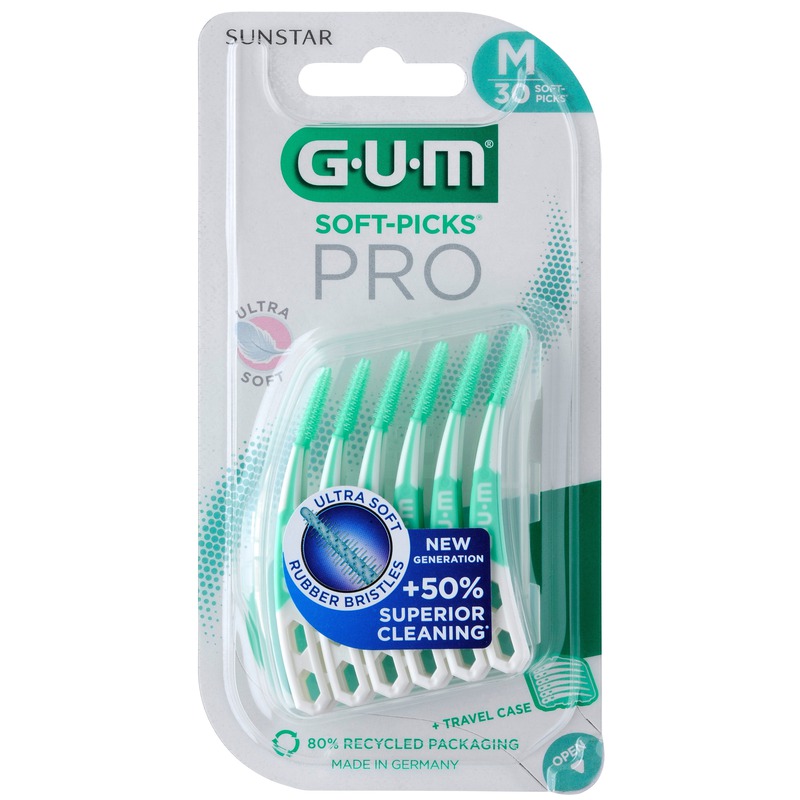
[ photo GUM brush ]

GUM interdental brush

A small bristle head on a flexible stick. Easy to handle. Available at any pharmacy or supermarket.
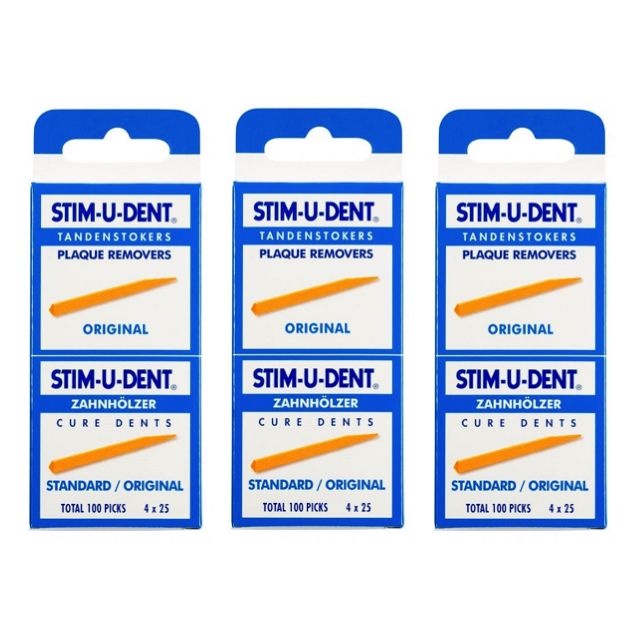
[ photo Stim-U-Dent stick ]

Stim-U-Dent wooden stick

A wooden stick. Moisten it first on your tongue โ€” the wood becomes soft and pliable.

There are certainly other and possibly better products. But above all: you need to be comfortable using whatever you choose. Because that's the only thing that counts.[3]

Why the Stim-U-Dent?
It is made from a type of wood that becomes soft and flexible when moistened on your tongue. This makes it easier to fit between the teeth and reduces the risk of damaging the gums.

Good enough is good enough

Scientists show that a small bristle brush โ€” in the right size โ€” removes more plaque than a simple GUM brush.[4] That's true.

But in practice, those small bristle brushes often require two or three different sizes. One gap is narrower than another. That demands a lot of motivation and patience.

A simple brush used every day gives a good result. Experience shows that you can effectively combat gum inflammation even with a basic brush.

Not the best brush, but the brush you use every day, works best.[5]

What about the small bristle brushes?

If you're motivated and want to go further, the small bristle brushes are certainly worth trying. TePe, Curaprox, and other brands make them in various sizes.[6]

You start with the smallest size and work from there. In areas with more space, you can then move to a slightly larger size.

For people who have undergone or recently completed periodontal treatment, this type of brush is essentially the standard. They receive detailed instruction and good guidance, and results are usually excellent.

In many cases, you won't need extensive periodontal treatment if you maintain your teeth well โ€” brushing electrically twice a day and using interdental brushes once a day. Ask your dental hygienist or dentist to help you get started and suggest the easiest tools for you.

The best tip

Choose a product you'll also use tomorrow and the day after โ€” every day. It should be a brush or stick that is easy for you to use. One product for the whole mouth, not three different ones for different spots.

You don't use a brush or stick for the technique โ€” you use it for your gums. If the gums bleed less and feel calmer, you're doing it right. Regardless of which product you use.

Not sure about something? Ask a professional.

Your dental hygienist or dentist is happy to help โ€” whether it's about the right brush size, pain during use, or any other question about your teeth.

Would you like to save this article?

Send it to yourself or someone else by email


Scientific references

  1. Chapple ILC, Van der Weijden F, Doerfer C, et al. (2015). Primary prevention of periodontitis: managing gingivitis. Journal of Clinical Periodontology, 42(Suppl 16):S71โ€“S76. doi:10.1111/jcpe.12366
  2. Lรถe H, Theilade E, Jensen SB. (1965). Experimental gingivitis in man. Journal of Periodontology, 36(3):177โ€“187. doi:10.1902/jop.1965.36.3.177. Classic experiment demonstrating that purely mechanical plaque removal can completely eliminate gingivitis, in most cases within two weeks.
  3. Sanz M, et al. (2020). Treatment of stage Iโ€“III periodontitis โ€” The EFP S3 level clinical practice guideline. Journal of Clinical Periodontology, 47(Suppl 22):4-60.
  4. Slot DE, Dรถrfer CE, Van der Weijden GA. (2008). The efficacy of interdental brushes on plaque and parameters of periodontal inflammation: a systematic review. International Journal of Dental Hygiene, 6(4):253โ€“264. doi:10.1111/j.1601-5037.2008.00330.x
  5. Wilson MG, et al. (1998). How patient compliance to suggested oral hygiene and maintenance affect periodontal therapy. Journal of Periodontology, 69(6):668โ€“675. doi:10.1902/jop.1998.69.6.668. Consistent use of simple tools correlates more strongly with healthy gums than the use of complex tools that is not maintained.
  6. Poklepovic T, Worthington HV, Johnson TM, et al. (2013). Interdental brushing for the prevention and control of periodontal diseases and dental caries in adults. Cochrane Database of Systematic Reviews, (12):CD009857. doi:10.1002/14651858.CD009857.pub2